
Thank you! Your submission has been received!
Oops! Something went wrong while submitting the form.
Hayfarmingis one of agriculture’s most weather-dependent and time-sensitive operations.Every hour between a clean cut and a dry, well-formed bale can mean thedifference between premium forage and spoiled feed. Understanding the equipmentinvolved helps producers at every level make smarter decisions before theseason starts.
Whether you’re putting up your first cuttingon a small property or managing several hundred acres across multiple harvests,this guide covers the core tools used in hay production, how they work, and howto choose the right setup.
Ag-Pro Companies serves hay producers acrosssome of the most productive agricultural regions in the country. Here is whatworks best in the field.
Yes, making hay can be highly profitable, butmargins depend on your operational efficiency, equipment uptime, and foragequality. High-quality hay, especially square-baled alfalfa or specialty grass,commands premium prices from equine markets and dairy farms.
To maximize profit, producers must minimizefield losses by using reliable machinery, cutting at the right maturity, andbaling at correct moisture levels to avoid spoilage. For instance, producers inKentucky and Tennessee feed a booming equine market that demands premium squarebales, while cattle operations across Texas and the Southeast rely onhigh-volume round bales to get through the winter. Getting hay from the fieldto storage with minimal losses, and in the fewest possible days, is where the profitis made or lost.
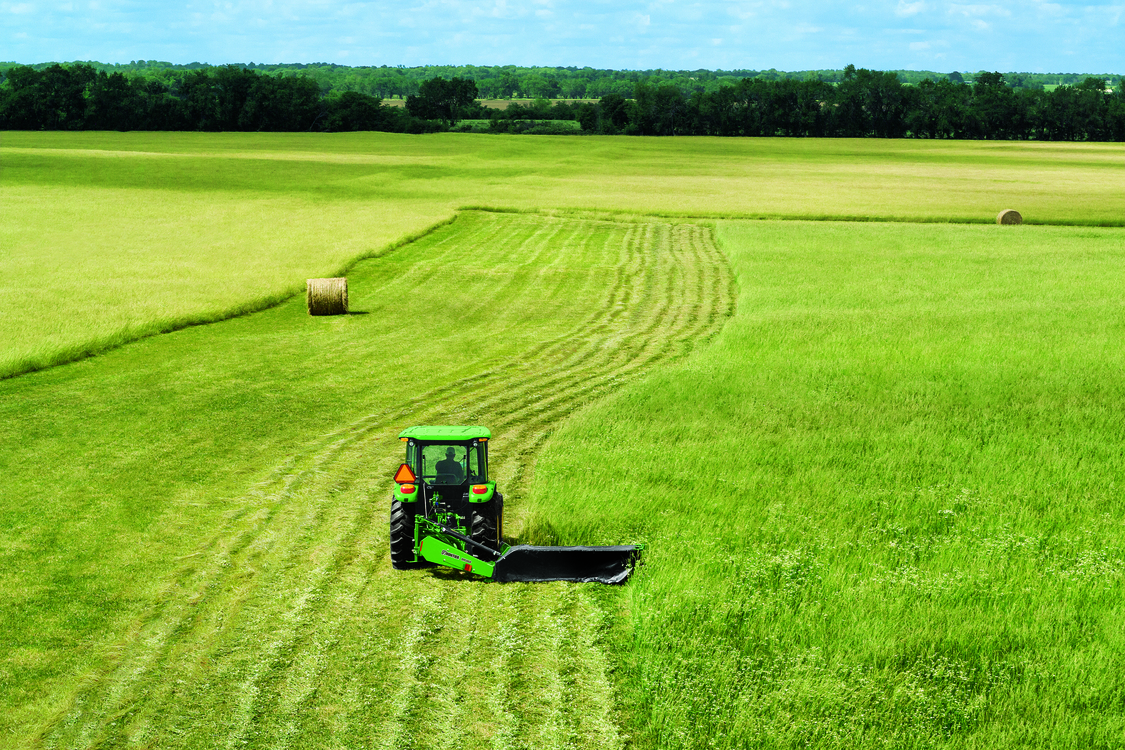
A John Deere disc mower uses multiple rotating discs fitted withreplaceable knives to slice cleanly through standing forage, maintaining highground speeds even in thick or lodged crops.
As a critical haymaker tool, getting the most out of your mowercomes down to a few key operational habits:
• Set the blade height:Adjust the skid shoes to maintain a stubble height of 2 to 3 inches. Thisprotects the plant’s crown for faster regrowth and keeps dirt out of thewindrow.
• Set the tractor RPM:Run at your tractor’s rated PTO speed (typically 540 or 1000 RPM) to keep themower discs spinning fast enough for clean shearing.
• Match speed toconditions: Maintain a consistent ground speed (typically 6 to 12 mph) toensure an even cut.
• Cut in the morning:Mow after the dew lifts but before afternoon heat to start the drying processeffectively.
Knowing how to operate the mower is only halfthe equation. Cutting at the right time in the crop’s growth cycle is whatdetermines feed quality.
The best time to harvest hay is at the crop’speak nutritional stage, just before it reaches full maturity. This timingstrikes the ideal balance between high yield and feed quality:
• For alfalfa andlegumes: Harvest at the late bud to early bloom stage (when roughly 10% of thefield is flowering) to maximize protein.
• For grass hays:Harvest during the boot stage, just as the seed head is about to emerge fromthe leaf sheath, to capture peak energy.
Throughout Ag-Pro’s footprint, this timingvaries by crop. Whether you are managing thick orchardgrass in Ohio,high-protein alfalfa in Kentucky, or warm-season coastal bermuda in Georgia andFlorida, cutting too late results in coarse, bulky forage with significantlyreduced feed value.
Tedding is the process of using a rotaryimplement (a tedder) to lift, fluff, and scatter freshly cut damp hay acrossthe field. By spreading the thick swath into a thin layer, tedding maximizesexposure to air and sunlight, which accelerates drying times and prevents damppockets of hay from rotting in the windrow.
Tedding is most valuable in the first 12 to24 hours after cutting when moisture is high. Running a tedder too lateincreases the risk of leaf shatter, particularly in delicate legumes likealfalfa. Once the hay reaches target moisture (typically 18 to 20 percent), arake gathers it into uniform windrows for the baler.
The two main types of hay bales, round and square, suitdifferent operations. Your choice depends on how you plan to store, handle, andsell your crop.
Round balers collect windrowed hay through a pickupmechanism and feed it into a forming chamber, where fast-moving rubber belts orsteel rollers spin the material into a cylinder from the inside out. Once thebale reaches its pre-set diameter, a wrapping system automatically binds itwith net wrap or twine and the rear gate opens to discharge the finished bale.
These weather-resistant bales typically weigh800 to 1,500 pounds and are well-suited to cattle operations and outdoorstorage. The tradeoff is that every stage — moving, feeding, and loading —requires a tractor and loader.
Square balers compress looseforage into dense, rectangular blocks using a four-step mechanical process:
• Pickup: A rotatingpickup assembly lifts the dry windrowed hay.
• Pre-compression: Feedforks push the hay into the baling chamber.
• Compression: Areciprocating plunger compacts the material into tight, layered slices called“flakes.”
• Knotting: Amechanical knotter wraps twine around the bale and ties it securely beforeejecting it out the rear.
Small square balers produce lightweight balesthat can be moved by hand, making them the preferred choice for horse ownersand retail markets. Large square balers offer high density and efficientstacking, which reduces transport costs for commercial operations.
The round bale vs square bale decision comes down toyour storage setup and target market. Round bales are faster to produce andshed water well outdoors. Square bales pack tighter for transport and selleasily to retail or equine customers. Many producers eventually run both to coverall bases.
A compact hay baler for small farms is theideal fit for horse properties, hobby farms, and producers working 20 to 50acres or less. These machines require less horsepower, cost less to maintain,and produce lightweight bales that can be handled easily without heavy loadertractors.
For operations requiring large volumes ofsilage or haylage, a JohnDeere forage harvester provides the throughput and chop precision thatdry hay equipment cannot match.
A self-propelled forageharvester cuts, chops, and loads high-moisture crops in a continuous, single-passoperation:
• Harvesting: Aspecialized header (like a rotary corn head or windrow pickup) feeds thestanding crop into heavy-duty feed rolls.
• Chopping: The rollsfeed the compressed material into a rapidly spinning cutterhead drum, choppingthe forage to a precise, pre-set length.
• Processing: Whenharvesting corn silage, a kernel processor cracks the kernels to improvedigestion.
• Loading: Anaccelerator fan blows the chopped crop through an adjustable spout directlyinto a truck or trailer driving alongside.
John Deere’s forage harvesters maintainprecise, consistent chop lengths across varying crop conditions, whichtranslates directly into better fermentation and optimal livestock performance.
Successful hay production requires matchingyour machinery to your acreage, crop types, storage, and market.
Ag-Pro Companies carries the full John Deerehay and forage lineup, including disc mowers, round balers, square balers, and self-propelledforage harvesters. With over 80 locations spanning Ohio, Kentucky, Tennessee,Georgia, Florida, North Carolina, and South Carolina, our team knows your localclimate and crops.
Stop by your local Ag-Pro dealership before the seasonstarts to evaluate your options and keep your harvest running smoothly.


